The AI Pull Request Body: h5i's Review Surface for Agent Work
When an agent writes the code and the PR description, the description is a self-report. h5i instead generates the review body from provenance it captured as the work happened — prompt, model, tests, risk signals, reasoning, agent messages — and upserts it as one sticky GitHub comment. The reviewer triages evidence, not a summary.
- An agent-written PR description is a self-report; h5i instead generates the body from captured provenance.
- The comment is upserted in place via a hidden marker — one sticky comment per branch, not comment spam.
- Five styles (receipt, review, detective, replay, minimal) render the same provenance for different readers.
A growing share of the branches a reviewer is handed today were written by an agent — and so was the PR description explaining them. That is the trap. When the same system authors the code and the summary, the summary is a self-report: a confident paragraph the model wrote about its own work, with no obligation to mention the test it skipped, the file it edited without reading, or the credential it pasted into a config. Reviewers know not to trust an author's self-assessment from humans; an LLM's prose is no more load-bearing, just more fluent.
You already know the standard moves here: write the PR body by hand, or let an AI summary bot read the diff and paraphrase it. The first is honest but expensive and rarely done well on agent branches; the second scales but only ever sees the result — the diff — never the process that produced it. The option you may not have considered is to generate the review body from captured provenance: the prompts, model and agent identity, test metrics, audit findings, and reasoning recorded as the work happened. The reviewer then reads evidence the author could not have quietly omitted, in the place review already happens.
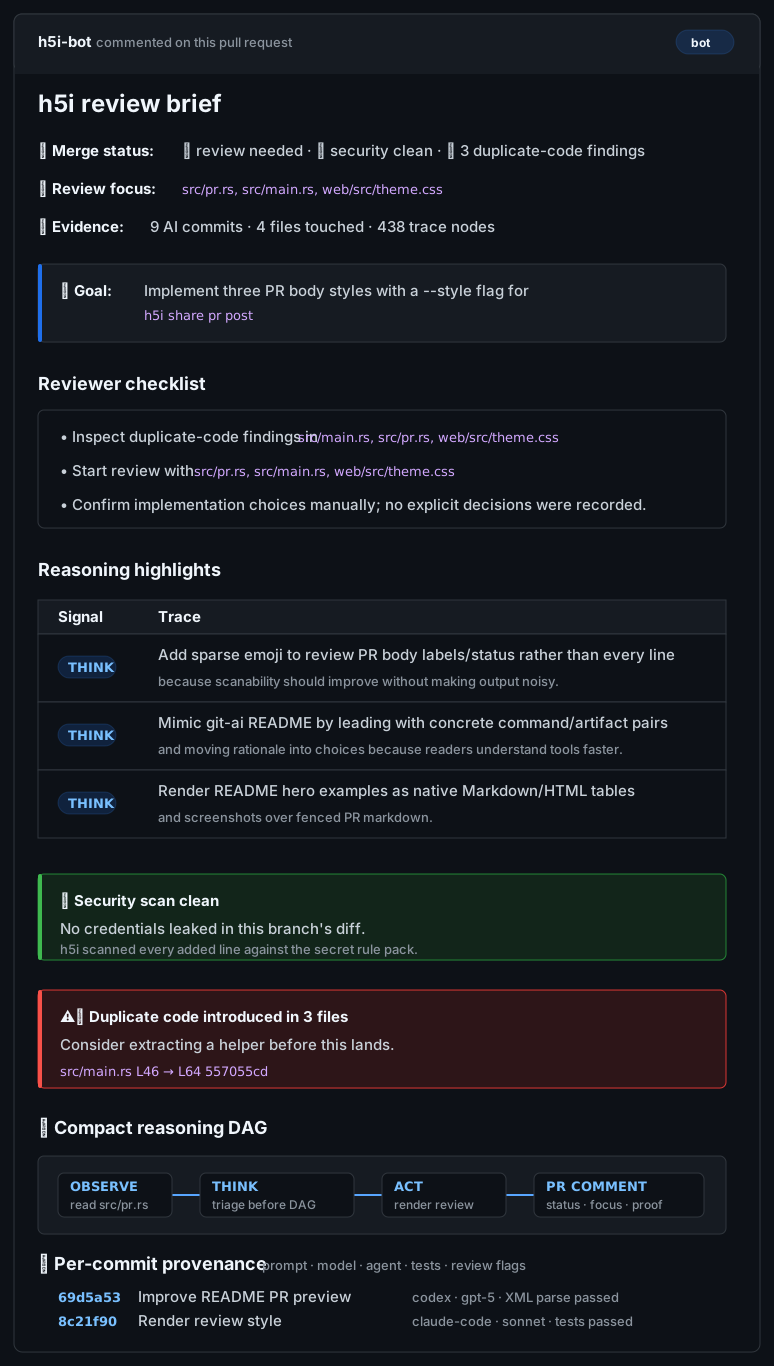
That is what h5i share pr post does. It renders h5i's
shared context DAG, commit
provenance, audit findings, and branch-scoped agent messages into a sticky GitHub
comment. Re-run it and h5i updates the same comment instead of spraying duplicates
across the thread. Its sibling, h5i share pr body, prints the same markdown
to stdout so CI can own the PR description directly.
What the PR body answers
The packet is organized around the questions a reviewer actually asks before approving an agent's branch. Each answer is rendered from a recorded signal, not generated prose — a section self-omits when its signal is missing rather than inventing a plausible-sounding filler.
| Reviewer question | h5i source |
|---|---|
| What was the agent trying to do? | Branch goal, captured prompt, milestones. |
| Which files deserve first review? | Footprint, churn, audit signals, context relevance. |
| Was the work tested? | Captured test metrics from h5i capture commit --tests. |
| What did the agent decide? | THINK entries and structured decision records. |
| What risks were detected? | h5i audit review: leaked secrets, blind edits, duplicates, CI changes. |
| Did agents coordinate on this? | Branch-scoped i5h review requests, risks, handoffs. |
Post or preview
The common loop is: render locally with --dry-run to check the body, then
drop the flag to upsert it onto the open PR. h5i share pr body takes the same
style and limit flags but never touches gh — it is the CI path.
$ h5i share pr post --style review --dry-run
# render the reviewer brief locally; no gh call

$ h5i share pr post --style review
# upsert the sticky comment on this branch's open PR
✔ Posted h5i comment on h5i-dev/h5i#418

$ h5i share pr post --style review
# re-run after more commits: same comment, edited in place
✔ Updated h5i comment on h5i-dev/h5i#418 (id 2391847706)

$ h5i share pr body --style replay --limit 50 | gh pr edit --body-file -
# CI path: write the rendered markdown straight into the PR description
--limit caps how many commits feed the packet (default 25); --number
pins a PR explicitly instead of auto-detecting from the branch. Both post and
body share the style, limit, and coordination flags.
Five styles, one record
Style changes only the hero block at the top of the comment — the first viewport a reviewer or a screenshot captures. The audit sections, reasoning DAG, coordination threads, and per-commit provenance below the fold are identical across styles, because they all read from the same recorded evidence. Pick the framing that fits the moment; the facts do not move.
| Style | What the hero surfaces | Reach for it when… |
|---|---|---|
receipt (default) | Stat card (commits, tests, est. cost), the triggering prompt, milestones. | You want one scannable, screenshot-able summary block. |
review | Merge status (✅/🟡), top focus files, an evidence line, and a short checklist. | A human is about to triage and merge — the reviewer-first brief. |
detective | Narrative: goal → alternatives considered/rejected → key insight → shipped. | The reasoning matters and you want it read top-to-bottom. |
replay | The reasoning DAG promoted above the fold, expanded, with milestone markers. | The process (read/think/edit shape) is the story. |
minimal | One-line headline, the goal, the swim-lane DAG. No tables, no dollar figures. | A routine internal branch wants provenance without the flourish. |
What is in the packet
Below the hero, every body renders the same ordered sections, each of which omits itself when it has nothing to say:
- 🔒 Credential-leak alert. If the audit found a secret on an added line, it is promoted above the hero as a rotate-before-merge banner — the leak is flagged, never reprinted.
- 🔁 Duplicate-code alert. Copy-paste the agent introduced, with the rule, file, and line that tripped it.
- 🧠 Reasoning DAG. The OBSERVE/THINK/ACT trace, collapsible below the
fold (and expanded in-hero for
replay). - 💬 Agent coordination. Branch-scoped i5h message threads — review
requests, risk callouts, handoffs — so a reviewer sees what the agents told each other.
Off with
--no-msg. - 📜 Per-commit provenance. One row per AI commit: model, agent, prompt, token count, and test result, collapsed automatically past five commits.
The coordination section is deliberately conservative about what it republishes. By
default it excerpts only review-typed messages (review request, risk, handoff, ask, and
their typed replies); casual FYI and free-text chatter stay metadata-only
unless you pass --msg-bodies, and --msg-limit caps how many
threads render. Pulled message fields are untrusted input, so an unrecognized message
kind is sanitized and escaped before it reaches the comment — a hostile kind
can not break out of its rendered cell. This is the same
terminal-injection defense the messaging
layer applies everywhere it shows pulled text.
The sticky comment, not comment spam
CI that posts a fresh comment on every push turns a PR thread into a changelog nobody
reads. h5i avoids this with a hidden marker. Every comment it writes begins with
<!-- h5i:pr-comment v1 -->. On each run, pr post lists the
PR's comments, finds the one starting with that marker, and edits it in place via
gh api … -X PATCH; only if none exists does it post a new one with
gh pr comment. The result is exactly one h5i comment per branch that tracks
the latest state of the work — your re-runs update history rather than burying it.
How this compares
The PR comment is one rendering of a durable record, not the record itself. h5i keeps the
truth in Git sidecar refs (refs/h5i/context, refs/h5i/notes,
refs/h5i/memory), and the same evidence also renders as a terminal prelude, a
local dashboard, or a compliance report. So the fair question is not "is a generated
comment nice" but "what does this rendering let a reviewer see that the
alternatives do not."
| Approach | Good | Gap |
|---|---|---|
| Hand-written PR description | Human judgment, real context, honest caveats when the author is diligent. | Expensive; rarely done well on agent branches; still a self-report — the author chooses what to mention. |
| Generic AI PR-summary bot | Zero-effort, scales to every PR, decent at "what changed" on small diffs. | Sees only the diff. No prompt, model, tests, risk rules, or reasoning — it can not surface a skipped test or a blind edit because those are not in the diff. |
| h5i provenance packet | Renders captured evidence the diff can not contain: prompt, model/agent, tests, audit signals, reasoning, agent messages. Sticky, redacted, evidence-first. | Only as rich as what was captured — a branch that never ran h5i during the work yields a thin packet (it degrades to commit-level facts, not a fabrication). |
Reviewer workflow
A useful AI PR body should change review order. With --style review,
start at the merge-status line and the focus files h5i ranks highest, read the evidence
line and checklist, skim the reasoning highlights, then compare tests against the behavior
that changed. The comment never replaces the diff; it tells you where the diff is most
likely to hide a mistake.
This matters most on large generated patches. Without provenance, a reviewer spends equal attention on formatting churn and on security-sensitive changes. With it, blind edits, uncertainty notes, skipped tests, generated configuration, and high-churn files move to the top of the queue — and the routine churn drops to the bottom where it belongs.
The same record helps after merge. If a production issue surfaces later, the sticky comment is a compact account of the original task, the evidence available at review time, and the assumptions that were accepted. That is incident context, not just a tidier PR.
Requirements and failure modes
h5i share pr post needs the GitHub CLI installed and authenticated. It fails
fast and explains itself when:
ghis missing or not authed — it can not resolve the repo; rungh auth loginand checkgh auth status.- No open PR for the branch — auto-detection has nothing to target; push
the branch and open a PR, or pass
--number N. - You want a preview, not a post — use
--dry-run, orh5i share pr bodyto print markdown for your own workflow.
The richest packets come from branches that used h5i throughout: a context goal and traces
from the session hooks, h5i capture commit --tests for provenance and metrics,
and h5i audit review before requesting review (Codex branches wire the same via
h5i hook codex prelude and h5i hook codex sync). A branch that
skipped all of that still renders — just with less to show. For the risk model behind the
audit signals, see the AI-generated code audit
framework.
Frequently asked questions
Does h5i write my pull request description for me? Not a hand-written
narrative. It renders a packet from the provenance already captured on the branch.
h5i share pr body prints that markdown to stdout (pipe it into
gh pr edit --body-file -); h5i share pr post upserts it as a sticky
comment. The content is generated from evidence, not authored by the agent under review.
Will re-running h5i share pr post spam the PR with comments? No.
Each comment carries a hidden marker (<!-- h5i:pr-comment v1 -->). On
re-run, h5i finds the marked comment and PATCHes it in place via gh api, posting
a new one only when none exists — so there is exactly one sticky h5i comment per branch.
How is this different from a generic AI PR-summary bot? Summary bots read the diff and paraphrase it. h5i's packet renders provenance the diff can not contain: the prompt behind each AI commit, model and agent identity, captured test metrics, audit risk signals, and recorded reasoning. A diff summary tells you what changed; the packet tells you what the agent was asked, what it knew, and what it checked.
What if there is no open PR or gh is not authenticated?
pr post resolves the repo and PR number via gh and fails with a
clear message if auth is not clean, if no PR exists (push and open one, or pass
--number), or if no number is returned. Use --dry-run to render
locally, or h5i share pr body for CI.
Could the PR comment leak secrets or private agent chatter? The packet is
secret-redacted — detected credentials become a rotate-before-merge alert, not reprinted.
The coordination section excerpts only review-typed i5h messages by default; casual chatter
stays metadata-only unless you pass --msg-bodies. Untrusted pulled fields are
sanitized and escaped against injection.
Conclusion
The reason to generate the PR body instead of writing it is not convenience. It is that an agent's own summary and a diff-only bot share the same blind spot: neither can show you what was left out. A skipped test, a file edited without being read, a secret pasted into a config, a rejected alternative — these live in the process, not the patch. h5i captures the process as it happens and renders it where review already occurs, sticky and redacted, with the audit signals that did not make it into the diff promoted to the top.
The packet does not ask you to trust the agent. It gives you the evidence to decide, lets you disagree with every line of it, and — because it is one rendering of a durable record — leaves the same facts available later as the dashboard, the compliance export, or the post-incident account. The PR comment is just the view the reviewer happened to need first.
Build a review-ready workspace
Try h5i on your next AI-assisted branch: create a sandboxed workspace, capture the run, and post a review-ready PR brief.
Star on GitHub Read the guides