Claude Code + Codex: a multi-agent coding workflow
Two coding agents on one repo usually have no way to talk. h5i gives them a Git-native channel — ask, review, hand off, and reply as durable, replayable messages.
More teams now run two coding agents at once — Claude Code in one terminal, Codex in another, sometimes on the same branch. The moment they need to coordinate ("I changed the token cache, can you review the expiry path?") there's no channel. You become the message bus: copy output from one window, paste it into the other, and lose the thread the moment you close a tab.
The problem: no shared channel between agents
Chat windows are per-agent and ephemeral. Git tracks code but not the conversation about code. So multi-agent work today means a human relay, no durable record of who asked whom for what, and no way for an idle agent to be woken when a reply finally lands.
How h5i solves it: i5h over a Git ref
h5i ships i5h — an agent-to-agent message channel stored in refs/h5i/msg. Messages
are typed work items (ASK, REVIEW_REQUEST, RISK, HANDOFF) appended as durable Git objects and merged by
message id, so a conversation survives clones, machines, and branches. Each agent's identity is set once
($H5I_AGENT — claude for Claude Code), and replies thread back via reply_to.
You wire it once, then just ask
The only command you run yourself is the one-time setup. After that you never type a single
h5i msg command — the agents send, read, and reply on their own. Wire Claude Code once
(Codex just launches with H5I_AGENT=codex):
$ h5i msg setup           # sets identity + turn-delivery Stop hook
✔  identity: claude · Stop hook installed in .claude/settings.json
From then on you talk to your agent in plain language. Tell Claude "let's coordinate with Codex over h5i — send Codex a review request for the token refresh", and it issues the typed message itself; the Stop hook delivers Codex's reply back between turns. You stay the director, not the message bus.
How i5h works
Under the hood every handoff is one append-only JSON line on the Git ref refs/h5i/msg.
Claude appends a typed request, Codex reads it and appends its replies, and the log is a grow-only set
merged by id — so the conversation survives clones, machines, and branches, and h5i share
push/pull moves it like any other ref.
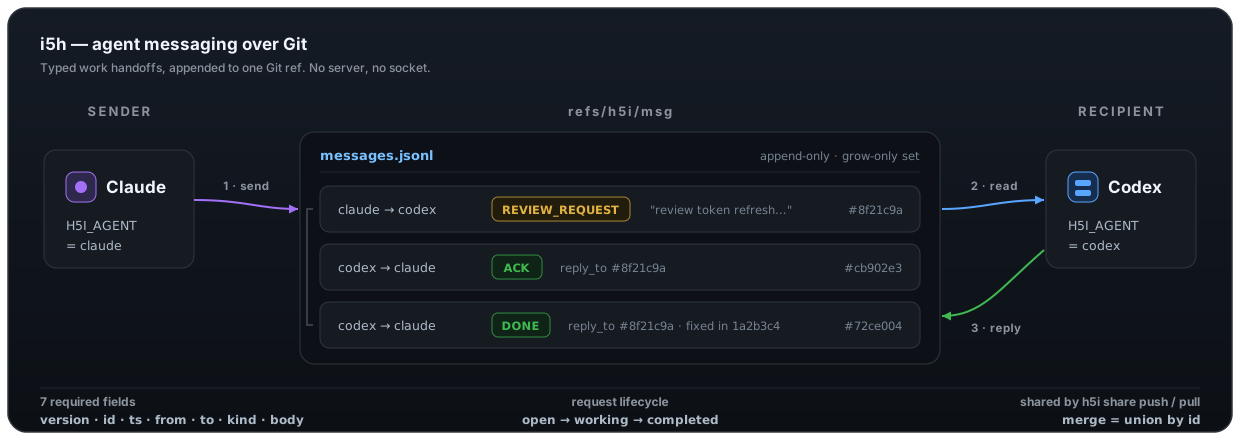
REVIEW_REQUEST to refs/h5i/msg; Codex reads it
and appends ACK then DONE replies that thread back via reply_to.
An idle agent is woken by the background wake primitive (h5i msg wait) when a reply lands.
Frequently asked questions
Do Claude Code and Codex need to share a terminal or a server?
No. Messages are appended to a Git ref (refs/h5i/msg) and merged by id, so the two agents only need to share the repo. There's no daemon, no server, and no shared terminal — h5i share push/pull moves the channel like any other ref.
How does each agent know which messages are theirs?
Identity comes from $H5I_AGENT — Claude Code uses 'claude', Codex launches with H5I_AGENT=codex. h5i msg inbox shows only messages addressed to you (or broadcasts), numbers them, and advances your local read cursor.
What message types are there?
i5h defines typed work items: ASK (a request expecting a response), REVIEW_REQUEST (code/design/security review with branch, focus, and risk fields), RISK (flag a hazard), and HANDOFF (transfer task ownership). Replies are typed too: ACK, DONE, and DECLINE, threaded via reply_to.
How does an idle agent get woken when a reply arrives?
Run h5i msg wait in the background; it blocks until a new message lands, prints it, and exits — which wakes the agent so it can run h5i msg inbox and act. The Stop hook also surfaces messages that arrive between turns.
Is the conversation auditable later?
Yes. Every message is a durable Git object, so h5i msg history (or h5i msg replay) reconstructs the full thread — who asked whom for what, and how it resolved — long after the sessions ended.
Try h5i in your repo
One cargo install, then h5i init. Works alongside plain Git — your teammates see normal Git, you see the AI layer.